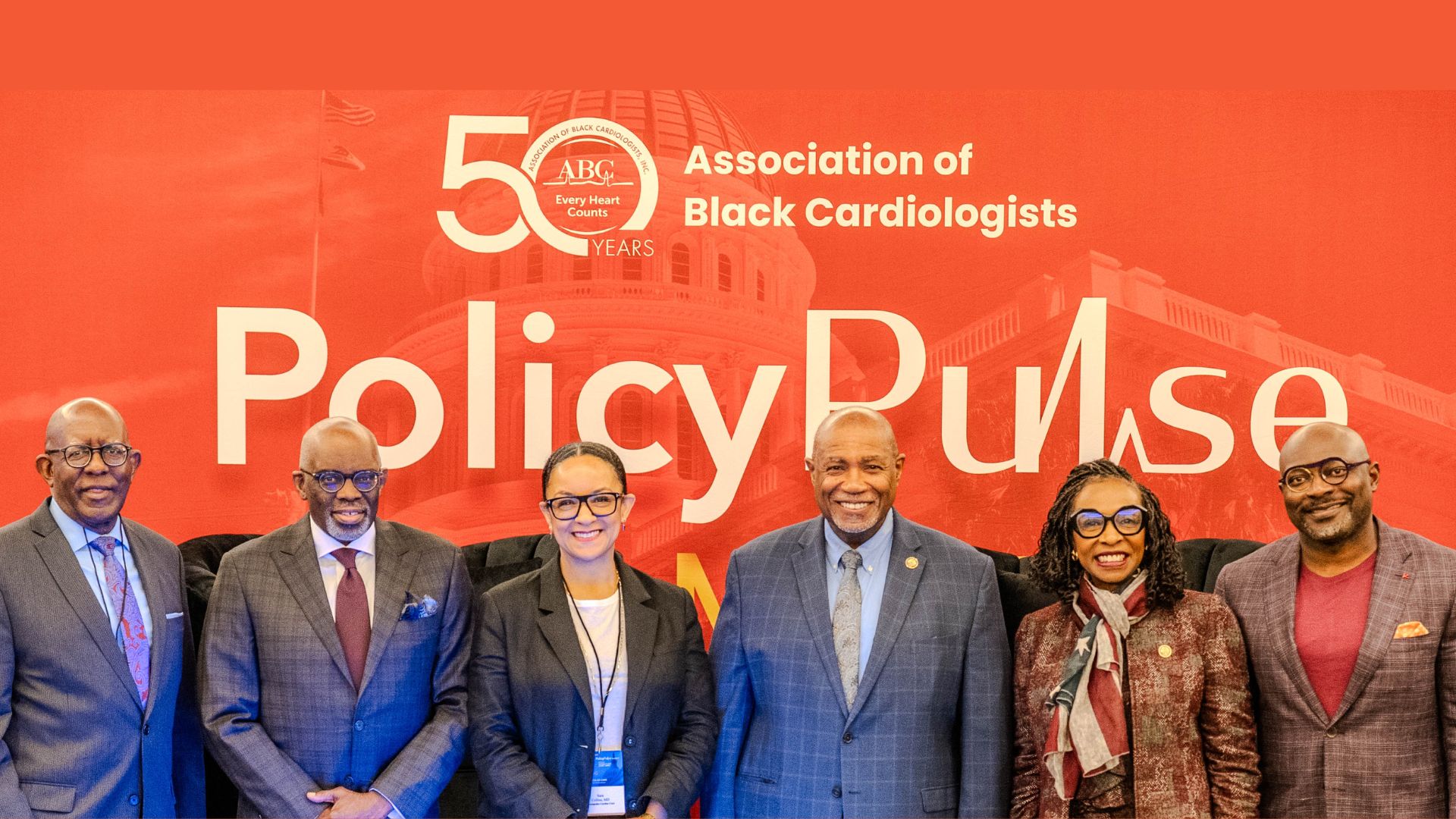
The Association of Black Cardiologists (ABC) hosted its 2025 Policy Pulse Summit in Washington, D.C., gathering policymakers, clinicians, and health equity leaders to focus on prevention, access to cardiovascular care, and policy-driven solutions to persistent health gaps.
Association of Black Cardiologists
2025 Policy Pulse Summit
Bridging Gaps in Cardiovascular Care Through Policy and Innovation
Event Summary
October 10, 2025
Introduction/Overview
On Friday, October 10, the Association of Black Cardiologists (“ABC” or “the Association”) hosted its Third Annual Policy Pulse Summit – a gathering of ABC members and stakeholders from across the cardiovascular care community to discuss priority issues related to the prevention, treatment, and management of cardiovascular disease, with a focus on addressing the needs of underserved communities. This year’s theme – “Bridging Gaps in Cardiovascular Care Through Policy and Innovation” – focused on addressing access to cardiovascular care, ensuring access to evidence-based cardiovascular treatments and interventions, making the business case for advancing cardiovascular health, and leveraging technology and innovation to expand access to cardiovascular care.
The event was held in Washington, D.C. as part of a larger, multi-day gathering of ABC members and supporters to celebrate the Association’s 50th Anniversary and discuss other topics of importance to the ABC, its members, and the patients they serve . The following provides a high-level summary of the presentations and panel discussions and the key takeaways from this important conversation.
Welcome and Framing Remarks
ABC Health and Public Policy Committee Co-Chair Dr. Sarah Collins kicked off the Summit with opening remarks, providing highlights of the ABC’s advocacy efforts and successes over the past year to fulfill the Association’s mission to “promote the prevention and treatment of cardiovascular disease, including stroke, in Blacks and other minorities, and achieve health equity for all through the elimination of disparities.” Among many activities, in 2025, the ABC:
- Sent letters to more than 160 Members of Congress outlining ABC’s policy priorities and making the case for cardiovascular disease prevention and care—including underscoring the staggering costs of cardiovascular care and health inequities.
- Developed new educational materials to help policymakers better understand ABC’s policy positions and reform ideas to major challenges facing chronic disease and cardiovascular care.
- Played an instrumental role in the reintroduction of R. 307, the Amputation Reduction and Compassion (ARC) Act of 2025, which would provide coverage for PAD screening among at-risk Medicare and Medicaid beneficiaries and establish a national PAD education program. To-date, ABC’s advocacy has helped secure more than 40 additional cosponsors for the bill.
- Helped build support for the reintroduction of R. 4231/S.1973, the Treat and Reduce Obesity Act (TROA), a bipartisan, bicameral bill that would allow Medicare Part D to cover FDA-approved anti-obesity medications and broaden access to other obesity therapies.
- Drafted model legislation to classify self-measured blood pressure monitoring devices as durable medical equipment and met with Congressional offices to discuss introduction of the legislation.
- Secured additional cosponsors for R. 7482, the Women’s Heart Health Expansion Act, which would expand and fund the CDC WISEWOMAN program, which provides cardiovascular disease risk screenings and health promotion services to low-income women.
- Submitted a statement for the congressional record highlighting how prior authorization and step therapy harm patient care and exacerbate workforce burnout.
- Developed and submitted comments to the Centers for Medicare and Medicaid Services (CMS) on several pending policy issues, including: coverage for transcatheter edge-to-edge repair for tricuspid valve regurgitation, transcatheter aortic valve replacement, ultrasound-based renal denervation , and anti-obesity medications.
A Call to Action from Members of Congress
Congresswoman Yvette Clarke (D-NY-9), Chair of the Congressional Black Caucus, helped open the event with keynote comments about the challenges of access to care and health disparities across the country. She highlighted the disproportionate rates of chronic disease, including cancer and heart disease, among Black Americans and discussed the need to support historically marginalized and underserved communities with meaningful legislative measures that help improve their lives. The Congresswoman noted that she understands firsthand the importance of the work that ABC and its members do because of her own lived experience. She shared a personal story about her companion of more than 30 years who experienced a cardiac event while shoveling snow; tragically he did not survive. She noted that too many members of the Black community die prematurely from preventable cardiovascular disease. Congresswoman Clarke urged all Summit attendees to be changemakers and work together to identify solutions.
Following Congresswoman Clarke, Congressman Herb Conaway, Jr., M.D. (D-NJ-3), a practicing internist, addressed the Summit attendees and spoke about the importance of primary and specialty care. The Congressman highlighted the essential role that Medicaid plays for the vitality of the nation’s hospitals, nursing homes, and community health centers. He noted that cardiovascular disease and stroke remain leading causes of death in the United States, claiming a life every 33 seconds, with an economic cost projected to reach $2 trillion by 2050 if nothing is done to stem the tide of disease. To help change the current trajectory, Congressman Conaway called for the enactment of legislation to expand education and screening for peripheral artery disease prevention (PAD); expanded access to remote patient monitoring, self-measured blood pressure devices, and telehealth, particularly for underserved communities; greater investment in chronic disease prevention at the Centers for Disease Control and Prevention (CDC), Health Resources and Services Administration (HRSA), and the National Institutes of Health (NIH); and programs to prevent and reduce the use of tobacco and vaping, including eliminating menthol from such products.
Fireside Chat: Ensuring Access to Cardiovascular Care Across Rural and Urban Communities
Dr. Faluso Fakorede moderated a “fireside chat’ with Angelle Kwemo, Chief of Staff to Rep. Sheila Cherfilus-McCormick (D-FL-20). They discussed a range of issues impacting the health policy arena and highlighted the need for new policies and programs to improve access and outcomes for undeserved communities. Additionally, they discussed the Congresswoman’s AED legislation, which was recently signed into law. This law provides grants to primary and secondary schools to support student and staff defibrillator training in schools. They celebrated the power of public policy in improving the lives of individuals, families, and communities and noted the growing need to address problems with the national health care system. They agreed that coverage and access are rights and not privileges and that coverage of screening for PAD and anti-obesity drugs is a justice and affordability issue that urgently needs to be addressed. Dr. Fakorede thanked her for the Congresswoman’s support of the ARC Act of 2025 and for recently becoming the new co-chair of the PAD Caucus with her colleague Rep. Gus Bilirakis (R-FL-12).
Panel 1: Addressing Access to Care Challenges in Cardiology Deserts
Moderator: Sara Collins, MD, ABC Health and Public Policy Committee Co-Chair; Interventional Cardiologist, Chesapeake Cardiac Care; Medical Director, Flourish Research Bowie
Panelists: Alexis Apple, Director, Federal Affairs, American Telemedicine Association (ATA)
Melvin Echols, MD, Chief Diversity, Equity, and Inclusion Officer, American College of Cardiology (ACC); Associate Professor of Medicine in Cardiovascular Disease, Morehouse School of Medicine; Associate Director, Clinical Research, Cardiovascular Research Institute
Anthony Fletcher, MD, FACC, FAHA, FSCAI, ABC President; Interventional Cardiologist, CHI St. Vincent Cardiology and Medicine Clinic
There are many places throughout the United States that do not have a practicing cardiologist – these areas are known as cardiology deserts. Earlier this year, ABC launched a campaign to address cardiology deserts to “confront the challenge of living in regions throughout the United States with limited access to cardiovascular services.” Panelists discussed the challenges that face individuals living in these areas and explored potential solutions. The panelists agreed that everyone should have same access to and quality of care irrespective of where they live or their life situation. Creating a special designation for cardiology shortage areas would help elevate the issue among policymakers.
Panelists explored the role of telehealth in addressing access-to-care challenges. With limited numbers of cardiologists in the United States, there was alignment that telehealth has the potential to significantly expand access to care, particularly for traditionally underserved communities. However, they noted that while telehealth holds “the promise of equal access to care” affordable access to high-speed broadband is a key component to address before telehealth can be deployed as a solution for all. It also was noted that telehealth should not be a replacement for in-person care but it should be a readily available option and that when utilized it ideally would be supplemented with community health workers who come from within the community. All panelists agreed that the federal government needed to take steps to ensure that coverage, reimbursement, and access to telehealth should be made permanent – as well as address barriers to practicing across state lines. Taken together, telehealth and community workers could significantly expand access for individuals living in cardiology deserts.
In addition to telehealth access, panelists discussed the need to ensure access to evidence-based cardiovascular care – both prevention and treatment – medications, devices, procedures, and other interventions. Barriers to evidence-based cardiovascular care that were noted included: prior authorization requirements from health plans/payors; traveling long distances to receive care; financial strain that hospitals are increasingly facing; reductions in outreach clinics due to cost constraints; growing numbers of uninsured and underinsured; lack of trust and/or health mis/disinformation among some communities; lack of awareness and education among providers and community members of the importance of low-density lipoprotein screening and appropriate treatment; greater need for primary prevention of cardiovascular disease through modifiable risk factors; and insufficient numbers of diverse clinicians. Panelists concurred that elevating outreach, education, recruitment, training, and mentorship efforts – including some initiatives that ABC is undertaking – would address many of these issues for rural and other underserved communities.
Panel 2: Facilitating Access to Evidence- Based Cardiovascular Treatments and Interventions
Moderator: Sara Collins, MD, ABC Health and Public Policy Committee Co-Chair; Interventional Cardiologist, Chesapeake Cardiac Care; Medical Director, Flourish Research Bowie
Panelists: Alan Balch, PhD, Chief Executive Officer, Patient Advocate Foundation and National Patient Advocate Foundation
Cassie Beisel, Senior Manager, Advocacy and Engagement, PAN Foundation
Eboni Morris, Director, U.S. Policy & Government Relations, Pfizer
There is a direct link between cost and access to care. For patients with cardiovascular disease, the ability to afford medications and clinical care is not optional – it is essential to their health, well-being, and survival. Patients are increasingly facing significant challenges in accessing the care and treatments their providers prescribe for them. Prior authorization places a significant burden on providers and patients, often delaying and sometimes entirely thwarting access to the best medicine for the patient. Step therapy requires patients and clinicians to jump through expensive, wasteful hoops before accessing the medication that is most appropriate/effective. Further, out-of-pocket (OOP) costs are standing in the way of patients accessing the care and treatments they need. Panelists agreed that health plans, insurers, and payors must be held accountable and that processes must be made easier for patients and clinicians alike.
Of concern is that OOP costs for medications are rising even with a federal cap of $2,000 a year for Medicare Part D OOP expenses. While many Medicare beneficiaries do not spend that much, they still cannot afford their OOP costs. By some estimates, up to 90% of those who do not receive the “low-income subsidy,” still face costs they cannot meet – including increasing premiums, coinsurance, and deductibles. While beneficiaries can now spread out their Part D costs over the course of a year, rather than having to pay it all at once at the pharmacy counter, use of this option remains very low. Panelists agreed that the Inflation Reduction Act’s provisions related to the Part D program and drug pricing have had some unintended consequences on patient care, which need to be addressed.
Panelists noted that bipartisan legislative proposals like H.R.5509, the Safe Step Act and H.R3514/S.1816, the Seniors Timely Access to Care Act – both endorsed by ABC – would help hold health plans accountable, streamline prior authorization processes, and ensure timely exceptions when insurer protocols delay treatment. With cardiovascular care, even brief delays can have life-threatening consequences; these bills would enact much-needed reforms that would significantly improve access to the care and medications that providers want to prescribe for their patients. Panelists noted that policymakers need to hear directly from patients and clinicians about the challenges caused by payor policies and processes. Elected officials need a combination of data and lived experience from their constituents to inform policymaking. Offering alternative approaches to utilization management, such as care pathways, could help advance patient-centered care and reduce the burden on all players in the health care system.
Luncheon Keynote Address: The Business Case for Advancing Cardiovascular Health
Presenter:
Yele Aluko MD, MBA, FACC
Health Industry Strategist | Global Health Equity Thought Leader
Former Chief Medical Officer, EY Americas
Dr. Aluko opened his remarks noting that he hoped following his presentation that the attendees would take away a “new way of thinking with an achievable roadmap toward measurable impact in cardiovascular delivery.” His presentation focused on understanding the state of cardiovascular health in America, exploring why progress in health equity has stalled and why gaps persist, discussing how the narrative must be reframed to make a business case for advancing cardiovascular health, and examining how the conversation can be moved from rhetoric to results.
Dr. Aluko explained that the cardiology workforce in the United States is experiencing greater strain due to a multitude of factors, including an aging population, rising disease burden, and procedural demand outpacing workforce growth. Further, administrative overload, burnout, and a shrinking training pipeline threaten sustainability, especially for Black cardiologists. In 2008, 90% of physicians practiced independently; today, nearly 90% are employed—a stark shift that reflects the profession’s erosion of autonomy and changing identity. Dr. Aluko noted that while up to 80% of cardiovascular outcomes stem from social and behavioral factors outside the clinic, current care models intervene only after risk becomes disease. He proposed that a sustainable future demands integrated prevention, early detection, and coordinated care and that efforts by education, biopharma, medtech, and professional societies must be aligned to shift investment from late-stage treatment to early-stage prevention and equity.
Dr. Aluko emphasized that for too long, social determinants of health – access, education, housing, food, jobs, and safety – have been wrongly cast as problems only for Black and Brown Americans, which is an inaccurate framing that has fueled inaction and left all Americans at risk. He pointed to the lack of standardized metrics, fragmented reporting tools, and inconsistent regulatory expectations within the field of health equity as several of the reasons why progress has been hamstrung. He explained that there is a growing need to reframe health equity as a national imperative – highlighting the fact that health inequities affect all Americans – not just racial minorities.
To that end, Dr. Aluko highlighted that the business case for health equity in cardiovascular medicine must be part of the broader case for advancing cardiovascular health for all; it cannot remain just a racial initiative. Dr. Aluko stressed that the effort must become systemic practice: Prove it works, show measurable value, and scale it to reach every vulnerable population. He explained that when academic rigor meets market validation – when purpose aligns with performance – we move from good ideas to lasting, systemic change.
Panel 3: Driving Innovation in Cardiovascular Care
Moderator:
Ilisa Halpern Paul, MPP, Health Policy Consultant to ABC, Senior Policy Advisor and Co-Lead Health Policy Team, Venable LLP
Keith C. Ferdinand, MD, FACC, FAHA, ABC Chief Science Officer; Professor of Medicine, Gerald S. Berenson Endowed Chair in Preventative Cardiology; Tulane University School of Medicine Troy L. Randle, DO, FACC, Cardiologist, Virtua Cardiology
Nicol Turner Lee, PhD, Director, Center for Technology Innovation (CTI), The Brookings Institution
Technologies, such as smartwatches, are becoming more ubiquitous, but not all individuals, patients, communities, and clinicians have equal access to or benefit from them. The nation’s health care system is broken and fractured and does not adequately meet the needs of people with chronic disease or individuals who are medically underserved. While technology has the capacity to bring better health and care to underserved individuals and communities, panelists agreed that relying solely on technology deployment is not the solution for addressing the underlying flaws of the health care system. For example, text reminders to seniors to take a blood pressure reading can be useful, low cost, and effective in managing hypertension – as can the use of an inexpensive validated blood pressure cuff. However, panelists noted that smartwatches or blood pressure cuffs are of little help if patients lack insurance or otherwise cannot afford access to clinical care and medication.
New therapies and medical innovations are only breakthroughs for the people who can afford or access them. Many individuals and families still do not have access to a smartphone, tablet, computer, or broadband, preventing them from leveraging the benefits of technology for their health. Affordability is one factor, but access, utilization, and outcomes are also shaped by health literacy, education, awareness, and other social determinants of health, such as access to healthy, fresh food. To that end, panelists noted that technologies’ influence on care quality and outcomes must be assessed and monitored, with particular emphasis on how breakthroughs are reaching and/or impacting Black and Brown communities.
Panelists also discussed numerous concerns and challenges with new technologies, particularly artificial intelligence (A.I.). Specific areas needing attention include: unrepresentative datasets/lack of sufficient diversity in data; inadequate investment in professional training and literacy; lack of transparency regarding use of A.I. in health care; bias in algorithms; and over-reliance on A.I. by clinicians and underutilization of proven effective interventions, such as hands-on examination of a patient. As such, panelists agreed that new tools need to be rigorously evaluated and steps need to be taken to ensure that the application of new technologies do not contribute to or deepen health disparities. In particular, panelists concurred that requiring certain patients (e.g., Medicaid beneficiaries) to wear technologies that track their activities are very worrisome and that patients need to be educated about their rights, privacy, and ability to consent.
Panelists emphasized that technology is only as good as the information driving it – if the wrong data is entered at the outset, the results will be flawed. . Panelists agreed that it is important to acknowledge and understand the strengths of A.I. as well as have a clear-eyed view of the real and potential pitfalls. For example, using A.I. to help review a scan is useful but should not replace physician oversight, understanding, and diagnosis. Panelists underscored the importance of training clinicians on how to appropriately use these tools and ensuring they understand that available technologies are not substitutes for in-person, hands-on patient care
Panelists acknowledged that A.I. can provide real value such as providing a second review of radiology imaging to help identify areas of concern on a scan. Moreover, panelists acknowledged that A.I. could help solve workforce shortages and access to care issues, such as by helping triage care, providing nutritional education to consumers (e.g., through “smart fridges”), and helping reduce clinician burnout through features like ambient listening that transcribe physician-patient conversations or drafting clinical documentation to streamline prior authorization requests and coverage appeals.
Panelists’ recommendations included: creating technical and societal standards for A.I.; undertaking assessments to determine if individuals tools meet those requirements; better A.I. privacy standards; ensuring individuals from underrepresented communities are involved in the creation, design, and deployment of these tools to both build trust and ensure the tools are not biased or contribute to/worsen inequities; keeping humans “in the loop” with technology to prevent tragedies – such as those recently reported in the media regarding missed diagnoses and youth with mental health disorders being directed toward self-harm; and continuing to advocate for solutions that address poverty and other underlying factors that impact access and equity
Conclusion
Dr. Jennifer Ellis closed the Summit by thanking the panelists and attendees. She highlighted several key themes discussed throughout the day — including legislative proposals that could transform the lives of millions of Americans living with cardiovascular disease and other chronic conditions; the economic and societal value of investing in cardiovascular care; the indispensable role of existing and emerging technologies in the U.S. health care system and the need for guardrails to prevent unintended consequences; and the ways administrative processes such as prior authorization divert valuable time from patient care and delay access to critical therapies.
Dr. Ellis reminded the audience that the there is still so much work to be done amid a moment of “great uncertainty and possibility”, and that concrete, scalable solutions exist to improve health outcomes, reduce health care costs, and strengthen the nation’s health care system for today and tomorrow. She urged attendees to carry the lessons from the Summit back to their respective organizations and continue the fight.